
Z-Image vs DALL-E 3: The 2026 Showdown for Photorealism
Description: A deep dive comparing Alibaba's open-source 6B model, Z-Image, against OpenAI's DALL-E 3. Discover why 2026 is the year specific, efficient local photorealism takes on the cloud giants.
The year 2026 has kicked off with a massive shift in the AI image generation landscape. For a long time, OpenAI's DALL-E 3 held the crown for conversational ease and "magic" — just type a sentence, and get a coherent image. But the tides are turning. With the release of Z-Image (and specifically the distilled Z-Image Turbo) by Alibaba's Tongyi team, the open-source community has a new champion that challenges the very philosophy of cloud-based generation.
In this showdown, we pit the new open-source contender against the established giant. Is it finally time to cancel your monthly subscription and invest in local hardware? Let's dive in.
1. Architecture: Mass vs. Efficiency
The most striking difference lies in the approach to model size and architecture.
DALL-E 3 is a behemoth. While OpenAI doesn't disclose exact parameter counts, it is widely understood to be a massive model running on clusters of enterprise-grade GPUs. It relies on a "kitchen sink" approach: throw enough compute and data at the problem, and the model will learn to understand everything. This comes at a cost — literally. You can't run DALL-E 3 on your laptop. You are tethered to the cloud, subject to rate limits, censorship, and subscription fees.
Z-Image, on the other hand, is a marvel of efficiency. It is a 6-billion parameter model built on the Scalable Single-Stream Diffusion Transformer (S3-DiT) architecture.
What does this mean for you?
- Speed: The distilled Z-Image Turbo can generate high-quality images in just 8 steps.
- Hardware Friendly: You can run this model on a consumer GPU with 16GB VRAM.
- Efficiency: It achieves state-of-the-art photorealism without needing the massive parameter count of its competitors.
For a deeper dive into how this efficiency is achieved, check out our article on Z-Image Turbo.
2. Photorealism vs. The "AI Look"
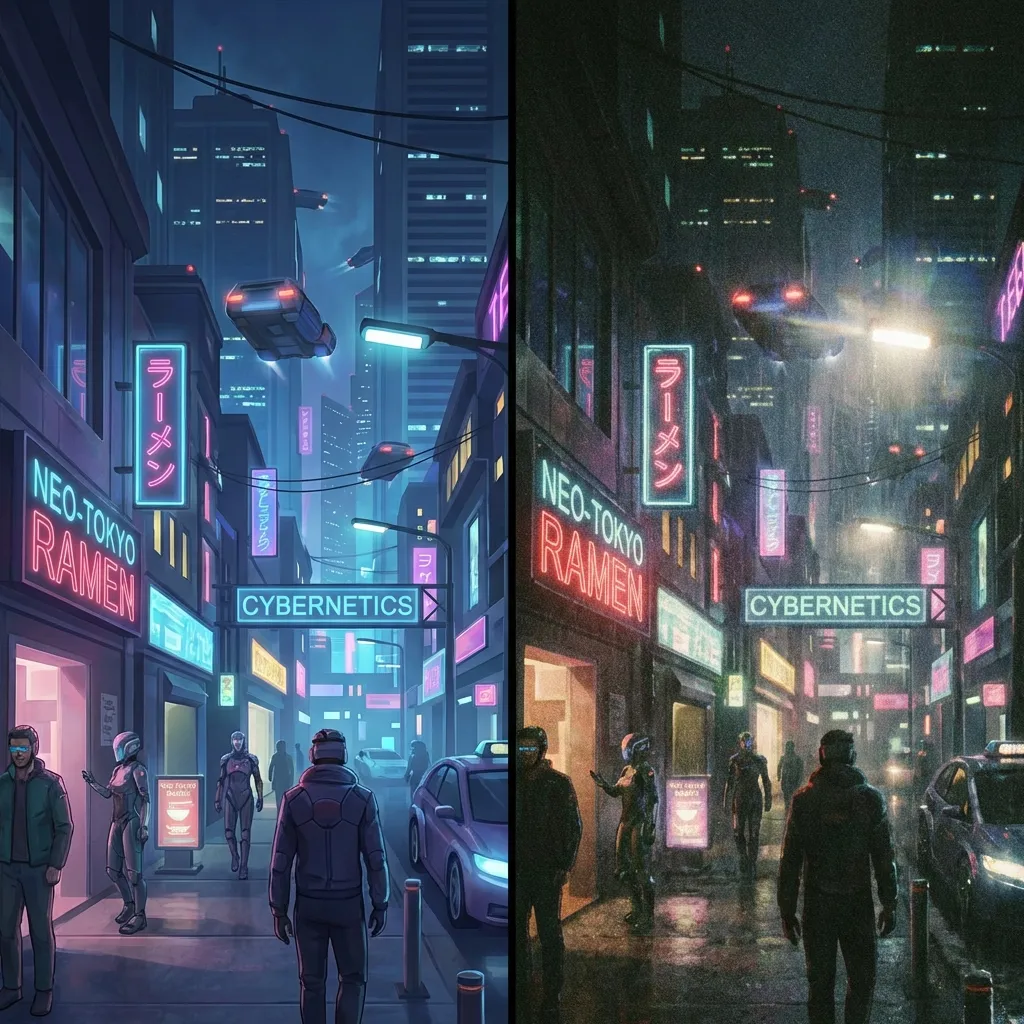
If you've used DALL-E 3, you know the look. It tends to produce images that are vibrant, smooth, and texturally perfect — often too perfect. It has a distinctive "plastic" sheen that screams "AI-generated." While great for illustrative work or ideation, it struggles when you need something that looks like it was captured by a physical camera.
Z-Image excels at photorealism.
Recent comparisons show Z-Image producing skin textures, lighting scenarios, and environmental details that rival 35mm photography. It doesn't shy away from "grit" or natural imperfections, which are crucial for believability.
- DALL-E 3: Best for digital art, illustrations, and following complex, multi-sentence prompts.
- Z-Image: Best for photorealistic portraits, product photography, and cinematic shots.

3. Control & The Ecosystem: Walled Garden vs. Open Field
This is perhaps the biggest deciding factor for professional users.
DALL-E 3 is a walled garden. You get what OpenAI gives you. You cannot fine-tune the model on your own characters. You cannot use ControlNet to dictate the exact pose of a subject. You are limited to text prompting and the in-painting tools they provide.
Z-Image is open source. This opens the floodgates for the community tools that professionals rely on:
- ControlNet: Use edge detection, depth maps, or pose skeletons to guide generation.
- LoRAs: Download or train small adapters to generate specific styles, characters, or objects.
- ComfyUI: Build complex, node-based workflows for unparalleled reproducibility.
If you are interested in setting this up yourself, we have a comprehensive Local Install Guide to get you started.
4. The Verdict: Which One is For You?
The choice between Z-Image and DALL-E 3 depends entirely on your needs in 2026.
Choose DALL-E 3 if:
- You want the easiest possible experience (Chat & Go).
- You need complex instruction following (e.g., "A red square on top of a blue circle next to a green triangle").
- You prefer a stylized, illustrative aesthetic.
Choose Z-Image if:
- Photorealism is your priority.
- You have a GPU with 16GB+ VRAM (or use a cloud GPU rental).
- You need precise control over composition (ControlNet) or style (LoRA).
- You want to own your workflow and avoid monthly subscriptions.
As we move further into 2026, the gap between open-source and closed-source models is narrowing. Z-Image proves that you don't need a massive server farm to generate world-class imagery — just smart architecture and a strong community.
Ready to try it out? Explore more about the ecosystem here.