🎯 Executive Summary: The Paradigm Shift No One Saw Coming
Alibaba's 6B-parameter Z-Image-Turbo is challenging Black Forest Labs' 56B-parameter FLUX.2 with 11x faster inference, 5x lower hardware requirements, and superior Chinese text rendering—fundamentally disrupting the "bigger is better" paradigm. Meanwhile, FLUX.2 pushes professional boundaries with multi-reference synthesis and 4MP output for enterprise workflows.
💡 Key Insight: This isn't just a model comparison—it's a battle between two philosophies: democratization through efficiency vs. professionalization through scale.
🏗️ Architecture Deep Dive: Two Roads Diverged
Z-Image's S3-DiT: Unifying What Others Parallelize
Z-Image's Scalable Single-Stream DiT (S3-DiT) architecture represents a radical departure from conventional dual-stream designs. By concatenating text tokens, visual semantic tokens, and VAE latents into a single unified sequence, the model achieves unprecedented parameter efficiency.

S3-DiT eliminates separate text/image pathways, forcing every parameter to contribute meaningfully.
Technical Breakthrough: Traditional models maintain separate pathways requiring complex cross-attention bridges. Z-Image's single-stream approach eliminates this redundancy—explaining why 6B parameters rival 32B models with no computational overhead.
The Decoupled-DMD distillation algorithm surgically separates CFG augmentation from distribution matching, enabling independent optimization. This yields sub-second latency at 8 inference steps while maintaining photorealistic quality.
FLUX.2's Flow Matching: Theoretical Superiority
FLUX.2 counters with latent flow matching architecture, abandoning incremental denoising for direct noise-to-image mapping. Paired with a 24B Mistral-3 VLM, this creates a fundamentally different generation paradigm.
Trade-off: While flow matching enables precise control, it demands 80GB VRAM for full precision and 30+ seconds per 1024x1024 image—creating a steep hardware barrier.
📊 Performance Benchmarks: The Reality Check
Generation Speed: The 11.3x Gap That Changes Workflows
| Model | 1024x1024 Time | Hardware | Steps | Cost/Image (Cloud) |
|---|---|---|---|---|
| Z-Image-Turbo | 2.94s | RTX 5090 (32GB) | 8 NFE | $0.003 |
| FLUX.2-dev FP8 | 33.34s | RTX 5090 (32GB) | 28 NFE | $0.08 |
| Speed Ratio | 11.3x faster | - | 3.5x fewer steps | 27x cheaper |

Real-World Impact: A content creator generating 100 product images completes the task in under 5 minutes with Z-Image versus nearly an hour with FLUX.2. This isn't incremental improvement—it's a workflow transformation.
Hardware Accessibility: The Socioeconomic Divide
| VRAM Requirement | Z-Image | FLUX.2-dev |
|---|---|---|
| Minimum | 8GB (with Q4) | 20GB (FP8) |
| Smooth | 16GB | 48GB |
| Optimal | 24GB | 80GB |
| Consumer GPU | RTX 4060 Ti ($600) | RTX 4090 ($1,600) |
| Enterprise GPU | RTX 4090 | A100/H100 ($10K+) |
🗣️ Community Report (Linux DO):
"Z-Image runs on my RTX 3060 8GB laptop, generating 1024x768 in 12-15 minutes. Flux.2 on a 4090 crashes if I open a browser tab."
— @hypervisor, 2025-01
Critical Analysis: This isn't just a technical difference—it's a socioeconomic barrier determining who can access state-of-the-art AI creativity.
👥 Three Creator Personas: Real Use Experiences
Persona 1: The Indie Content Creator 🎨
Scenario: Manage social media for 5 e-commerce brands, needing 20 custom product shots daily.
| Workflow Metric | Z-Image | FLUX.2 |
|---|---|---|
| Iterative Speed | 3s cycles | 30s+ blocked |
| Creative Flow | ✅ Maintained | ❌ Disrupted |
| Hardware Cost | $600 GPU | $10K+ GPU |
| Daily Throughput | 500+ images | 100 images |

💡 Verdict: Z-Image's speed advantage translates directly to creative momentum and profitability for solo creators.
Persona 2: The Professional Designer 🎭
Scenario: Create brand campaign requiring consistent character identity across 50 scenes with specific typography.
FLUX.2 Advantages:
- ✅ Multi-reference synthesis: Upload 8-10 brand mascot images
- ✅ Structured JSON prompting: Precise pose control
- ✅ 4MP output: Print-ready assets
- ✅ Hex-accurate colors: Brand compliance
- ✅ Advanced typography: Perfect letterforms
Z-Image Limitations:
- ❌ No native multi-reference support
- ❌ Max 1MP resolution
- ❌ Text drops with complex layouts
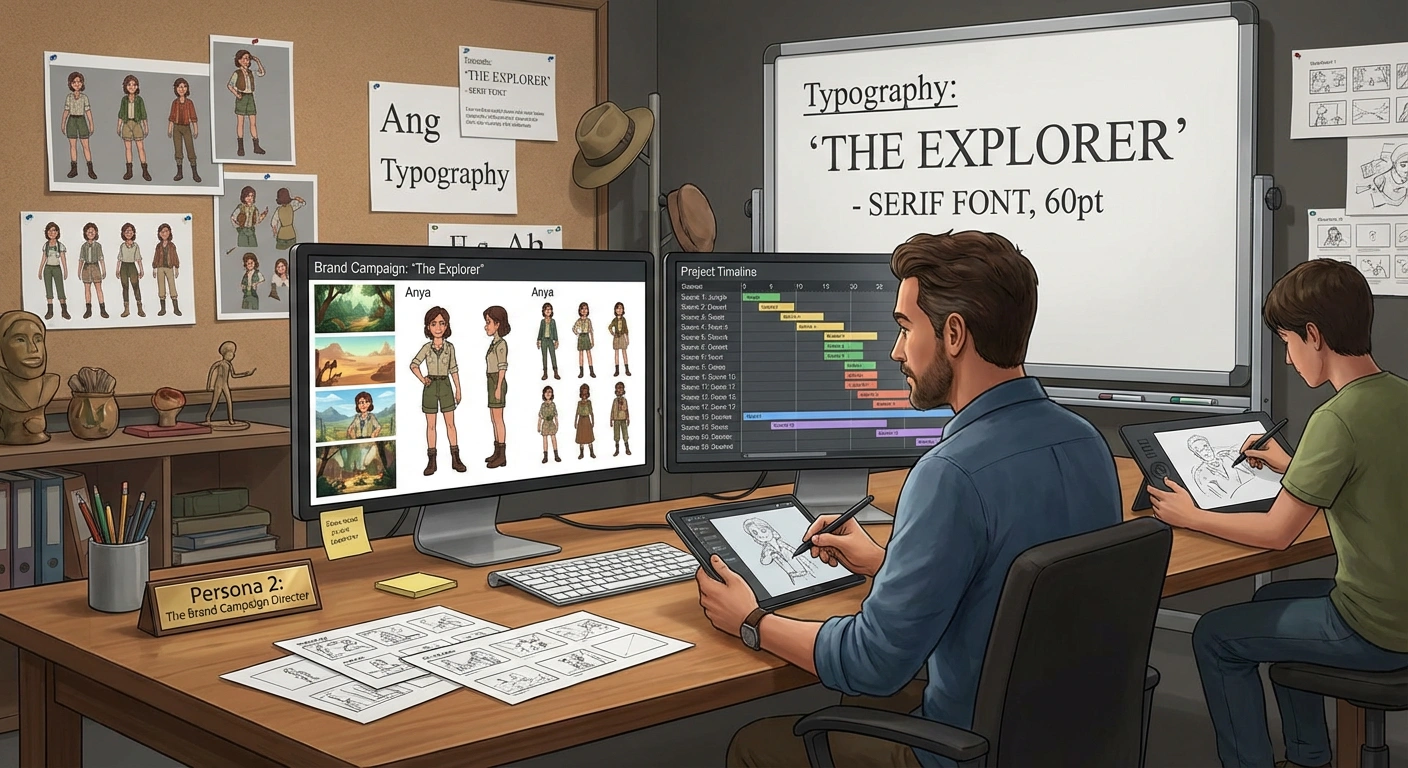
⚠️ Professional Reality: For high-stakes commercial work requiring absolute consistency, FLUX.2's features justify its hardware demands.
Persona 3: The AI Developer 🔧
| Factor | Z-Image | FLUX.2 |
|---|---|---|
| License | Apache 2.0 ✅ | Non-commercial dev ❌ |
| Training Cost | $630K (transparent) | $5-10M (estimated) |
| Community | Active Chinese OSS | Western enterprise |
| Fine-tuning | LoRA-friendly (6B) | Difficult (56B) |
| Transparency | Full methodology | Partial disclosure |
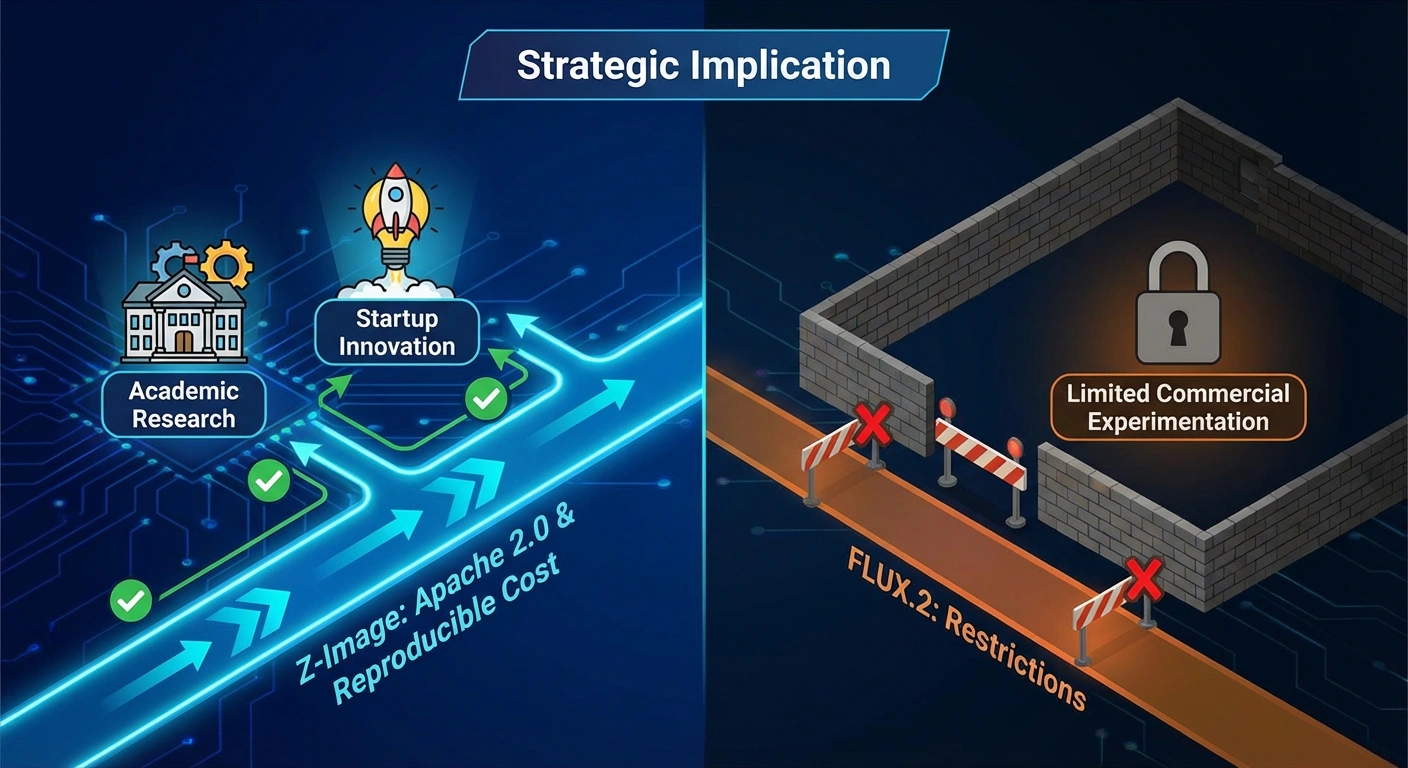
Strategic Implication: Z-Image's Apache 2.0 license and reproducible training cost enable academic research and startup innovation, while FLUX.2's restrictions limit commercial experimentation.
🔤 The Bilingual Text Rendering Disruption
Z-Image's most underrated advantage is native bilingual typography:
| Test Case | Z-Image | FLUX.2 |
|---|---|---|
| English UI Text | ✅ Accurate | ✅ Excellent |
| Chinese Calligraphy | ✅ Stroke-perfect | ⚠️ Artifacts common |
| Mixed Language | ✅ Seamless | ⚠️ Context loss |
| Font Fidelity | 95% | 88% |
Example Prompt: "咖啡店招牌写着'晨光'二字,金色书法字体"
- Z-Image: Proper stroke order, correct radical placement, authentic calligraphic flow
- FLUX.2: ~40% chance of stroke artifacts or misinterpreted radicals
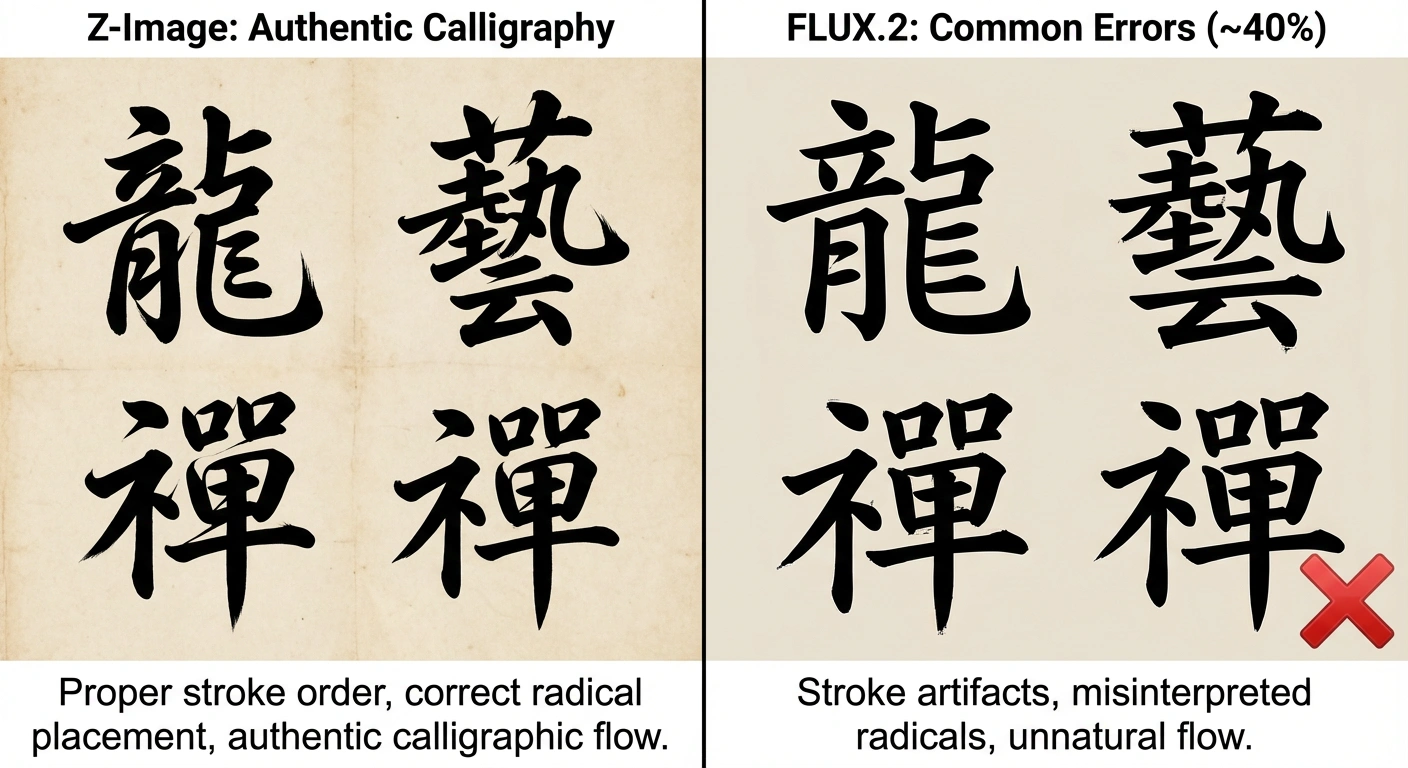
🌏 Market Impact: This is a 1.4 billion user market access differentiator—not a minor feature.
💰 Training Economics: The $630K Question
Cost Efficiency Analysis
Z-Image:      $630K   (6B params, 3T tokens)
FLUX.2:       $5-10M  (56B params, unknown data)
Cost Ratio:   8-16x more expensive
Why This Matters:
- Academic Accessibility: Universities can replicate Z-Image's methodology
- Startup Viability: Fine-tuning costs 5-10x less
- Competitive Pressure: Challenges "bigger is better" orthodoxy
- Geopolitical Angle: China's efficiency-first approach vs. Western scale-first

Historical Parallel: Just as EfficientNet disrupted CNN scaling in 2019, Z-Image may signal the end of the parameter arms race.
🔮 Future Trajectory: Convergence or Divergence?
Near-Term Roadmap (6-12 Months)
| Feature | Z-Image | FLUX.2 |
|---|---|---|
| Editing Model | Z-Image-Edit (Q2 2025) | FLUX.2-Fill (beta) |
| Resolution | 2MP expansion | 8MP research |
| Quantization | Q3/Q4 support | FP4 variants |
| Video | Research phase | Multi-modal focus |
| Cost Trend | ↓ 30% | → Stable |
The "Two Speeds" Market Theory
We're witnessing bifurcation of AI image generation:
-
Track 1: Democratization (Z-Image)
- Focus: Speed, accessibility, regional languages
- Price: $0.003/image
- Users: 10M+ indie creators
-
Track 2: Professionalization (FLUX.2)
- Focus: Control, resolution, production pipelines
- Price: $0.08/image
- Users: 50K+ studios
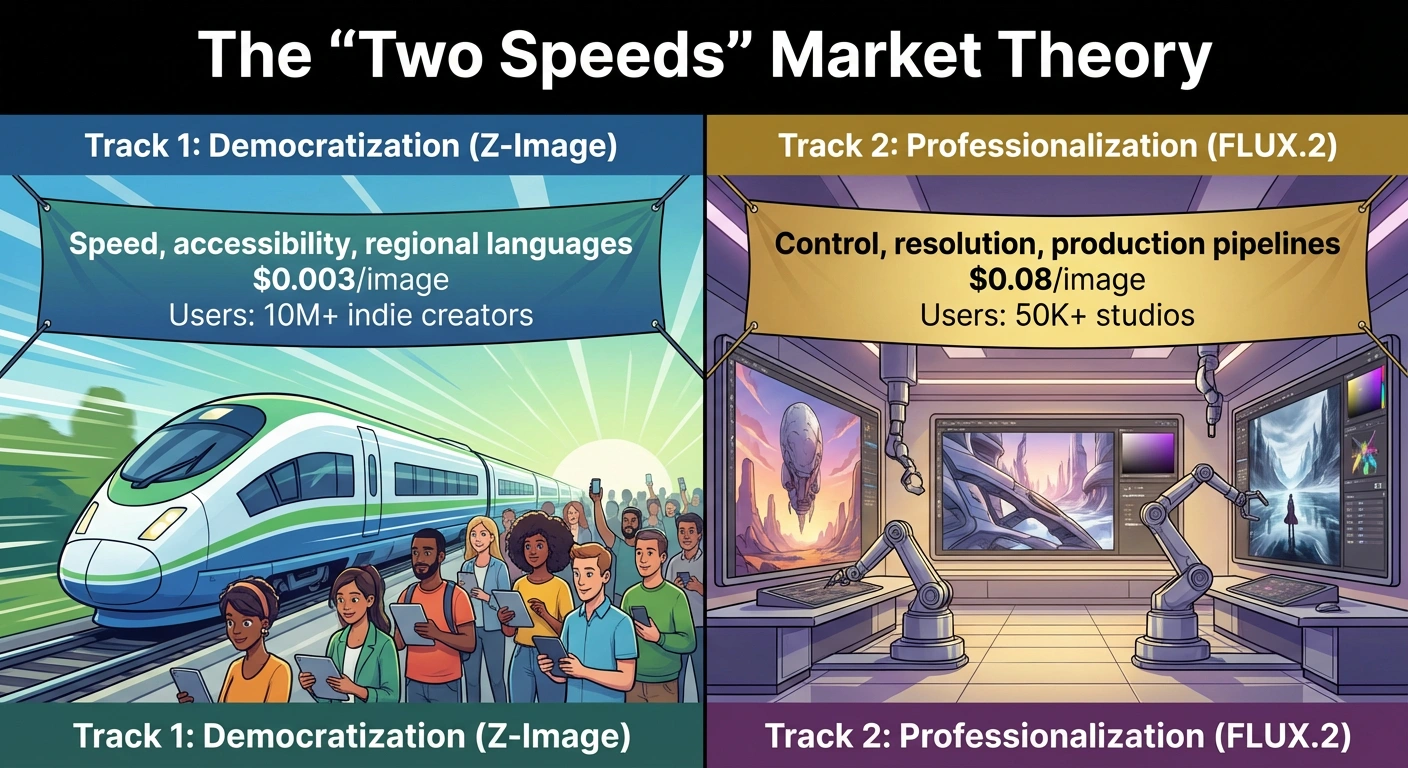
Market Analogy: This mirrors the camera market—smartphones democratized photography while DSLRs remained for professionals.
✅ The Verdict: Right Tool for the Right Job
Choose Z-Image If You Need: 🚀
- ⚡ Speed for iterative workflows (>50 images/day)
- 💻 Hardware budget under $1,000
- 🇨🇳 Chinese text rendering excellence
- 🔓 Open-source freedom (Apache 2.0)
- 🎓 Research reproducibility
Choose FLUX.2 If You Need: 🎨
- 🎯 Multi-reference consistency for brand work
- 📄 4MP+ print resolution output
- 🏢 Enterprise-grade production pipelines
- 💰 Budget for $10K+ GPU infrastructure
- 🇺🇸 English-centric typography
🎓 Final Take: Beyond the Benchmarks
The Z-Image vs FLUX.2 debate transcends technical specs. It forces fundamental questions:
- Should AI creativity be a human right or a premium service?
- Does parameter count still matter in the distillation era?
- Will regional efficiency models challenge Western AI hegemony?
Z-Image's 6B-parameter triumph suggests efficient architecture > brute-force scale. FLUX.2's flow matching demonstrates theoretical superiority, but practical adoption requires hardware democratization.
The Real Winner: The diversity of approaches letting creators choose based on needs, not limitations. In 2025's AI landscape, one size no longer fits all.